 866-774-3342
 info@pridereadingtutors.com
If you've been hearing the term "Science of Reading" everywhere lately—parent Facebook groups, school board meetings, the news—you're not alone. It’s become the buzzword in education, and for good reason. Decades of research have mapped out how kids’ brains learn to read, and many schools are finally shifting toward evidence-based instruction.
But here’s the catch: not every school that talks about Science of Reading is actually using it. And if you’ve ever felt that pang of worry watching your child struggle with reading homework—sounding out the first letter and then guessing the rest—you’re probably asking the same question a lot of parents ask: “Do we need a dyslexia tutor?” Or maybe you’ve typed reading tutoring near me into Google at 10 p.m. and hoped for a clear answer.
Let’s walk through the warning signs together—and what you can do if your child needs more structured support than they’re getting in the classroom.
Science of Reading: What It Actually Means
Before we dive into the warning signs, let me give you a quick foundation. The Science of Reading isn't a specific curriculum or program, it's a massive body of research (we're talking thousands of studies over 50+ years) about how kids actually learn to read.
The core finding? Reading isn't natural. Unlike spoken language, which kids pick up just by being around people who talk, reading has to be explicitly taught. And the most effective way to teach it is through systematic, structured phonics instruction, helping kids connect letters to sounds, blend those sounds into words, and build from there.
This approach is the opposite of what many of us experienced as kids: being told to "look at the picture" or "guess from context" when we got stuck on a word. That's called three-cueing (or MSV, meaning, structure, visual), and while it was popular for decades, research shows it actually trains kids to guess instead of decode.
Science of Reading Red Flags: 7 Signs Your Child’s School Is Still Teaching Guessing
You don't need to be a reading specialist to spot the red flags. Here are seven signs that your child's classroom might still be using outdated strategies, even if the school says they've adopted Science of Reading:
1. Your Child Is Told to "Look at the Picture" When They Get Stuck
This is the most obvious sign of three-cueing. If your child comes home and says their teacher told them to look at the picture to figure out an unknown word, that’s a guessing strategy—not decoding.
Yes, pictures are great for comprehension and engagement. But when it comes to reading the actual words on the page, your child needs to sound them out—not infer them from illustrations.
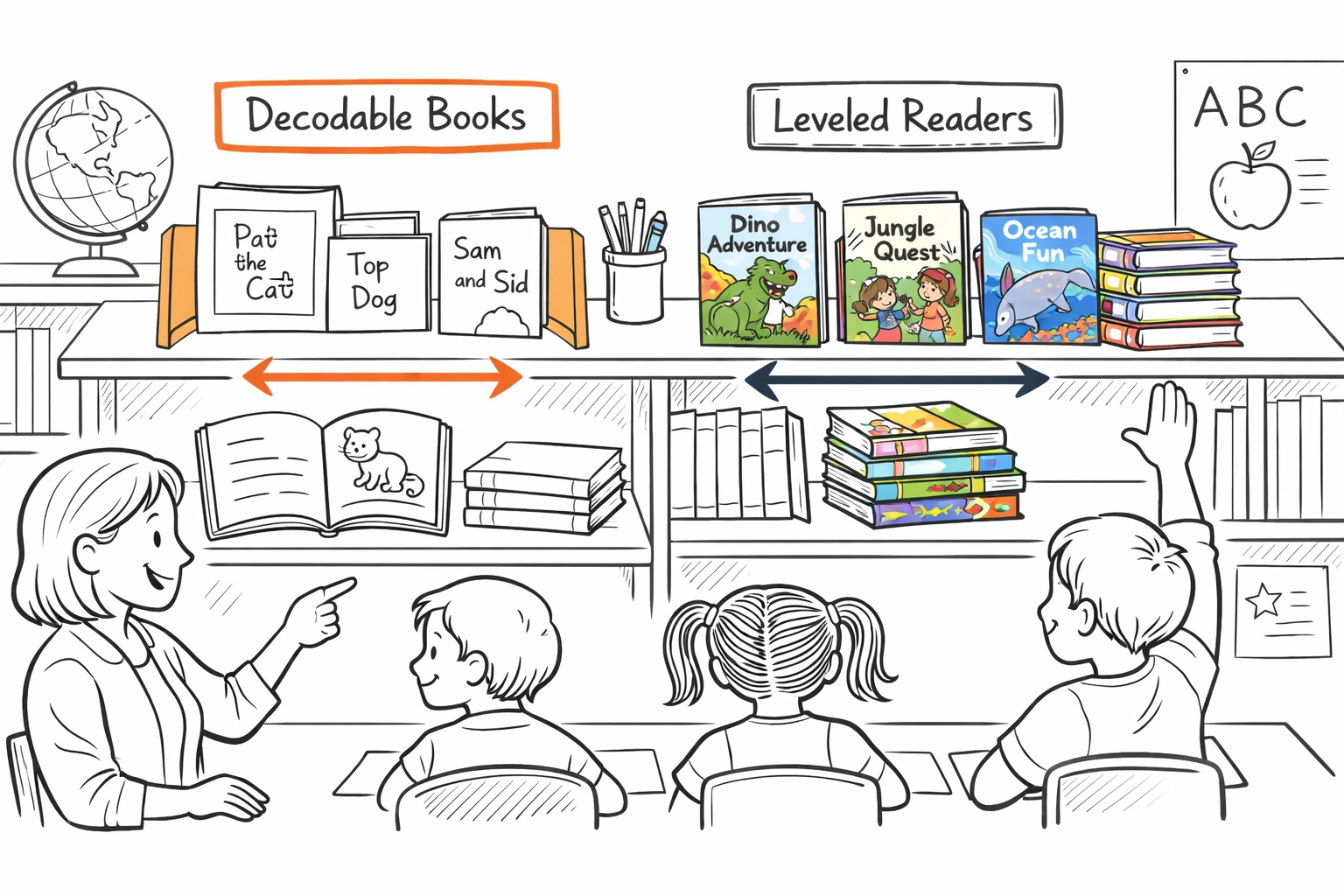
2. The Classroom Library Is Full of Leveled Readers Instead of Decodable Books
Walk into your child’s classroom (or peek in their book bag). Are they bringing home “Level E” or “Level J” books with rich illustrations and harder vocabulary? Those are leveled readers—often built to support three-cueing.
What you want to see, especially in kindergarten and first grade, are decodable books: simple stories where 80–90% of the words match phonics patterns your child has already been taught. Decodables let kids practice real skills—without having to guess.
3. Spelling Instruction Is Mostly "Memorize These Words"
If your child is bringing home a list of random high-frequency words to memorize each week (like “said,” “was,” “the”) with no explanation of letter-sound patterns, that’s a warning sign.
Science of Reading-aligned instruction teaches kids why words are spelled the way they are, using phonics rules and patterns. Even “tricky” words are often partly decodable—and learning those patterns builds stronger readers fast.
4. Your Child Skips or Substitutes Words That "Make Sense"
Does your child read “house” when the word is actually “home”? Or “dad” instead of “father”? If they’re swapping in words that fit the meaning but aren’t actually on the page, they’ve been trained to prioritize context and guessing over accurate decoding.
And I know this can feel overwhelming. This daily struggle often turns into frustration for both of you—because guessing works sometimes, but it falls apart when the text gets harder.
5. Teachers Talk About "Reading Strategies" More Than Phonics Skills
Listen to how your child’s teacher describes reading instruction. Do you hear phrases like “good readers use strategies” or “we’re working on picture clues and context”? That language typically points to balanced literacy or three-cueing.
Science of Reading classrooms talk about phonics skills, decoding, blending, segmenting, and fluency. The focus is on cracking the code of written language—not guessing your way through.
6. There's No Systematic Phonics Scope and Sequence
If you ask your child’s teacher, “What phonics skills are you teaching this month?” and they can’t give you a clear answer—or the phonics instruction feels random and disconnected—that’s a red flag.
Evidence-based phonics instruction follows a planned scope and sequence, teaching letter-sound relationships in a logical order (simple to complex). It’s structured, cumulative, and explicit—like a roadmap instead of a scavenger hunt.
7. Struggling Readers Get "More Time" Instead of Different Instruction
Here’s a big one. If your child is behind in reading and the school’s solution is basically “more time with the same program,” that’s usually not enough.
Kids who struggle with reading—especially kids with dyslexia—typically need different instruction, not just more of what isn’t working. They need intensive, explicit, structured literacy intervention, often through approaches like Orton-Gillingham tutoring.
Why Guessing Hurts (And Why It Matters More Than You Think)
You might be thinking, "Okay, but my child is reading. Does it really matter if they're guessing a little?"
Here's the thing: guessing strategies can mask problems in the early grades when books are simple and predictable. But as texts get longer and more complex, think third grade and beyond, kids who rely on context and pictures instead of solid decoding skills hit a wall.
They start to avoid reading. Homework becomes a battle. Confidence plummets. And the gap between them and their peers widens.
This is especially true for kids with dyslexia or other reading differences. These kids need more structure, not less. They need to be taught explicitly and systematically how the English code works, because their brains don't pick it up incidentally.
Breaking this cycle is crucial. And that's where a dyslexia tutor trained in Science of Reading methods can make all the difference.
Dyslexia Tutoring That Fills the Gap: Orton-Gillingham
If your child's school isn't providing the structured literacy instruction they need, you're not stuck. Private tutoring, especially through the Orton-Gillingham approach, is the gold standard for evidence-based reading intervention.
Here's what makes Orton-Gillingham (OG) different:
It’s systematic and cumulative. Skills are taught in a specific order, and each new step builds on what your child has already mastered. Nothing is skipped or assumed.
It’s explicit and direct. No guessing. No “figure it out from context.” Every sound, rule, and pattern is taught clearly—and practiced until it sticks.
It’s multisensory. OG tutors use visual, auditory, and hands-on practice to cement learning (like tapping sounds, building words with tiles, and saying sounds while writing).
It’s individualized. Lessons match where your child is right now. Need more short-vowel practice? Great—that’s the focus. Ready for syllable division? We move forward.
It’s diagnostic. OG-trained tutors constantly check what’s working and adjust in real time. Your child gets what they need, when they need it—without wasted time.
This is the kind of instruction that can change a reading trajectory. And please know: it can work even for kids who’ve been struggling for a long time.
What to Do Next (Without Overwhelming Yourself)
If you're nodding along to several of these red flags, please know: you're not overreacting, and you're not alone. Tons of parents are in the same spot, trying to figure out how to best support their child.
Here are your next steps:
Talk to your child's teacher. Ask specific questions: "Can you walk me through the phonics curriculum you're using?" "How are you supporting kids who struggle with decoding?" "Are there decodable books I can get for home practice?" You might get great answers: or you might get vague ones that confirm your concerns.
Request an evaluation. If your child is significantly behind, you have the right to request an evaluation through your school district to see if they qualify for special education services or a 504 plan. Don't wait: early intervention makes a massive difference.
Consider a private dyslexia tutor. Many families find that working with a reading specialist trained in Orton-Gillingham or another structured literacy approach gives their child the boost they need. At PRIDE Reading Tutors, we specialize in exactly this kind of support: whether your child has been diagnosed with dyslexia or is just struggling to keep up.
Look for reading tutoring near you. If you're searching for "reading tutoring near me," look for providers who use evidence-based methods and can clearly explain their approach. Ask about their training, their scope and sequence, and how they track progress.
Trust your gut. You know your child. If something feels off: if they're stressed, avoiding books, or falling further behind despite "good effort": that's real. Advocate for them. You are their best champion.
The Bottom Line: Science of Reading Isn’t a Trend—It’s What Works
The shift toward Science of Reading is one of the most exciting movements in education right now, and it's already transforming outcomes for thousands of kids. But the shift isn't happening overnight, and not every school has made the full transition yet.
If you see warning signs that your child's classroom is still encouraging guessing over decoding, you have options. You can ask questions, request better support, and: if needed: find a qualified dyslexia tutor who can provide the structured, evidence-based instruction your child deserves.
Reading struggles don't have to be permanent. With the right approach, kids can: and do: catch up, build confidence, and even fall in love with reading.
And if you're looking for a team that gets it, we’re here. At PRIDE Reading Tutors, our Reading Specialists use Orton-Gillingham and the Science of Reading to help kids crack the code—one sound at a time. Reach out if you’d like to talk through what support could look like for your child.
You’ve got this. And your child? They’ve got you.
Quick Summary & FAQ (For Busy Parents + AI Search)
Quick Summary
- Science of Reading = explicit, systematic phonics + decoding (not guessing from pictures/context).
- If your child is being taught to “look at the picture,” reading may look okay early on—but often breaks down as texts get harder.
- Kids with dyslexia (and many other struggling readers) typically need structured literacy, not “more of the same.”
- Orton-Gillingham is a structured, multisensory approach commonly used in effective dyslexia tutoring.
- If you’re searching “reading tutoring near me,” prioritize providers who can explain their scope/sequence, progress monitoring, and training.
FAQ
Is three-cueing part of the Science of Reading?
Not really. Three-cueing teaches kids to use meaning, sentence structure, and visual cues to guess words. Science of Reading instruction prioritizes decoding—matching letters to sounds and blending them accurately.
How can I tell if my child is guessing instead of decoding?
Look for word substitutions that “make sense” (home/house), skipping small words, or relying on pictures. A strong decoder is usually more accurate—even when the word is unfamiliar.
When should I consider a dyslexia tutor?
If reading feels unusually hard, progress is slow, your child avoids reading, or they’re falling behind despite effort, a dyslexia tutor trained in structured literacy can be a helpful next step. (This blog can’t diagnose—an evaluation is a great starting point.)
What should I ask when looking for reading tutoring near me?
Ask: “Do you use a structured literacy approach (Orton-Gillingham / Science of Reading)?” “What scope and sequence do you follow?” “How do you measure progress?” “What training do your tutors have for dyslexia and decoding?”
Do you offer online tutoring too?
Yes. PRIDE Reading Tutors offers online tutoring nationwide, plus in-home tutoring in select locations and Specialty Instruction (SDI) support for students with IEPs/504 plans.